Every mature performance marketing channel has a forecasting layer. Then there's influencer.
- Google Ads: Keyword Planner gives you expected CPC, search volume, and competitive density before you spend a cent.
- Meta: the Ads Manager projection tool shows expected reach, impressions, conversions, with confidence bands.
- Programmatic display: bid landscape tools project win rates by price point.
- Connected TV: every major DSP publishes audience reach curves.
- Affiliate: networks publish historical EPC by vertical, by offer, by traffic source.
- Influencer marketing: vibes.
The largest discretionary spend category in performance marketing — forecasted to cross $32B globally in 2026 — runs on screenshots, gut feel, and decks from agencies whose compensation is misaligned with your ROAS.
This is not a sustainable equilibrium. Categories don't stay this analog forever. We're at the Bloomberg Terminal moment.
The current state: zero published accuracy benchmarks
Pull up the websites of the top 12 influencer marketing platforms today: CreatorIQ, Aspire, GRIN, Modash, Klear, Upfluence, Mavrck, Tagger, Traackr, Influencity, IZEA, HypeAuditor.
Count how many publish accuracy benchmarks on the predictions they offer.
The answer is zero.
Some publish "engagement rate predictions" or "fraud scores." None publish: when we predicted X, the actual outcome was within Y% of X in Z% of cases. No confidence intervals. No backtests. No transparent methodology. No accountability.
Now imagine if Google Ads launched without ever publishing how close Keyword Planner forecasts are to actual results. The category would not have grown to where it is. Forecasting accountability is what built every other performance channel. Influencer is still pre-that.
Why this is the moment
Three things are happening simultaneously in 2026 that make a forecast-engine category inevitable:
1. The data substrate exists now
Five years ago you could not build a credible CPA prediction model for influencer because the data was locked inside platforms, signed deals were private, and post-campaign attribution was a smoking ruin. Today: API access has matured (with restrictions, but real signal), the long tail of brand-shared performance data has aggregated into proprietary databases, and the math (gradient-boosted models, Bayesian hierarchical models, transformer-based content embeddings) is well-understood. The technical bottleneck is gone.
2. The buyer is demanding it
Per the same IMH 2025 survey, 78% of brand-side buyers say they want "predicted outcomes" before committing to a creator deal, up from 41% in 2022. That's not a gradual curve. That's a step function. CFOs got involved. Performance teams that report to growth got involved. The buyer changed.
3. The compensation structure is misaligned with status quo
Most agencies charge a percentage of media spent, which means they make more when you spend more, regardless of whether the spend works. The buyer increasingly knows this. A forecast layer changes the conversation from "trust us" to "here's the predicted CPA, here's the actual CPA, here's the delta." Once the buyer has tasted that, they don't go back.
What a real influencer forecast engine needs to do
The bar is not "predict whether a campaign will succeed." That's astrology. The bar is the same bar Google Ads cleared 20 years ago:
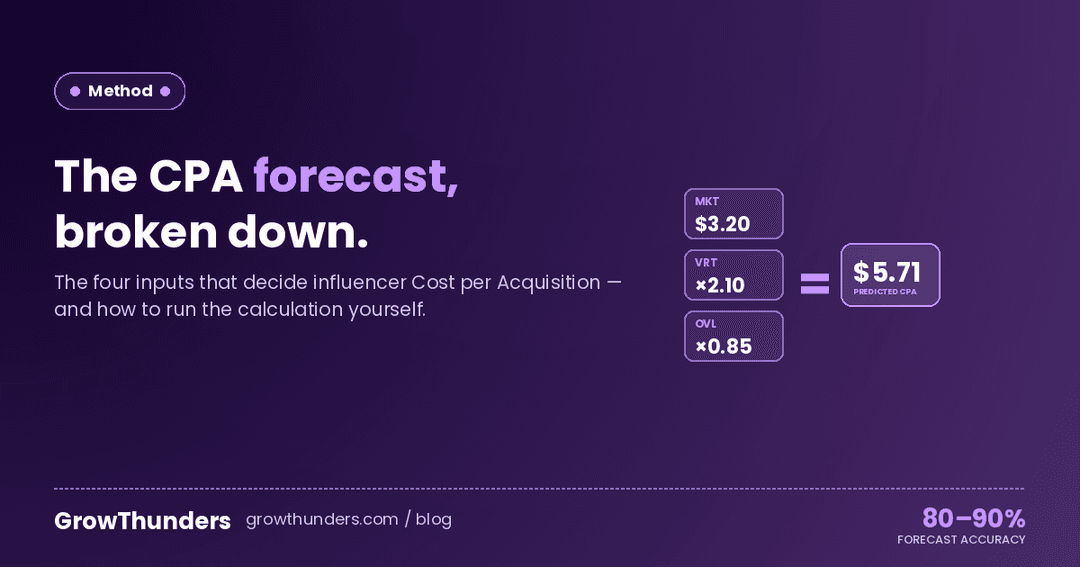
- Predict a specific outcome metric (CPA, CPM, ROAS, branded search lift)
- Provide a confidence interval around the prediction (e.g., "$14 CPA, 80% CI: $9–$22")
- Publish backtest accuracy quarterly (MAPE, calibration curves, vertical breakouts)
- Update the model when reality diverges and disclose model versions
- Allow customer-side validation — give me the test set I can verify against
This is just rigorous forecasting hygiene. Every other performance channel got there. Influencer will too, because the gap between the demand for predictability and the supply of predictability is the largest open-air arbitrage in performance marketing right now.
What the incumbents will do
They will add "AI predictions" to their existing UI. Most of these will be glorified engagement-rate estimators dressed in forecasting language. The tell will be the absence of published accuracy data. If a platform claims "AI-powered CPA prediction" and refuses to tell you their MAPE on a holdout set, they are selling vibes with a confidence-inducing UI.
The buyers who win are the ones who insist on accuracy disclosure as a vendor selection criterion in 2026. Make it a procurement requirement. Watch how fast the category responds.
The category-creating insight
Bloomberg Terminal didn't win because the data was unobtainable elsewhere. It won because it made the data legible, comparable, and decision-ready in a workflow built for the buyer, not the seller.
Influencer marketing's Bloomberg Terminal moment is not a fancier creator search tool. It's the first product that lets a Head of Growth type a brief, see a ranked list of creators with predicted CPA and confidence intervals, run the campaign, and watch the model self-correct against actual outcomes. With the accuracy of the predictions published, public, and audited.
Until that exists at scale, influencer marketing will remain the largest performance channel without a forecasting layer. Once it exists, the channel will quietly become the most predictable performance channel — because the data substrate (real human attention, attribution-linked outcomes, creator-level historical performance) is actually richer than what Google Ads has to work with.
What changes for buyers
The next 18 months will sort buyers into two camps:
- Camp A: continues to buy creators the way they always have, gets gradually outperformed, blames "the algorithm" or "creator fatigue"
- Camp B: insists on predicted outcomes with confidence intervals, makes vendor selection a function of forecast accuracy, compounds an information advantage
Camp B is small today. Camp B will be the entire market in five years. The Bloomberg Terminal moment is not a marketing pitch. It is the inevitable maturation of a category that has been pre-quantitative for too long.
Make sure you're not the last buyer running on vibes.