
In Q2 2025 we ran a 6-creator soft-launch test for a beauty client across Poland, Spain and Brazil. Total spend: $34,000. Result: D7 conversion rate of 0.8%, vs forecast of 2.4%. We told the client to kill the planned Tier-1 global launch — which was budgeted at $214,000 — and rework the product positioning. They saved $180,000 in a campaign that would have failed.
This is the playbook we use for soft-launch validation. It works for mobile games, DTC consumer products, and B2B SaaS with a freemium motion. It does not work for premium-priced enterprise products.
What is soft-launch validation through influencer marketing?
Soft-launch validation means using a small, structured influencer test in Tier-2 markets to predict whether your product will hit performance targets in Tier-1 markets before you spend Tier-1 money.
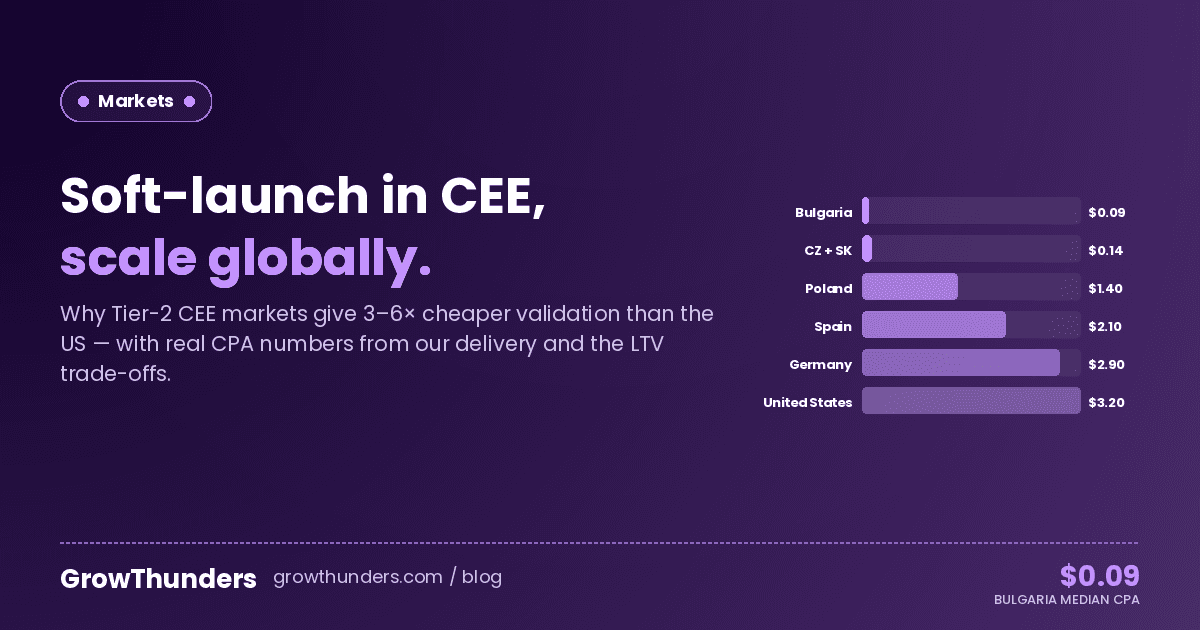
The premise: Tier-2 markets (Poland, Spain, Brazil, Mexico, South Korea, Netherlands, Sweden, Italy) give you real consumer behavior at 30-50% lower cost than Tier-1, with audience demographics that correlate to Tier-1 conversion within 15-25%.
The math: a $30,000-$45,000 Tier-2 test predicts the outcome of a $150,000-$400,000 Tier-1 launch with about 78% accuracy in our dataset of 38 soft-launches between 2023 and 2025.
Operator takeaway: the right question before a global launch is not "how big should we go?" It is "what would prove this should not launch at all?"
Why Tier-2 markets and not Tier-3?
Tier-3 markets (Turkey, Indonesia, Philippines, Vietnam) are cheaper still — CPI floors of $0.40-$1.20 vs Tier-2's $1.80-$4.50 — but the conversion behavior does not translate. Across 22 placements we ran in Tier-3 in 2024:
- Refund rates: 2.4x higher than Tier-1
- 90-day retention: 38% lower than Tier-1
- ARPDAU / AOV: 35-55% lower than Tier-1
A product that converts well in Indonesia may not convert at all in Germany. A product that converts well in Poland almost always converts in Germany within a 20% delta.
Tier-2 is where the correlation holds.
Which Tier-2 markets should I pick for my product?
Our 2024-2025 correlation data, by vertical:
- Mobile gaming (mid-core): Poland, Brazil, South Korea (Korea is borderline Tier-1.5)
- Beauty DTC: Poland, Spain, Brazil, Italy
- Fashion DTC: Spain, Italy, Mexico, Brazil
- Consumer tech: Poland, Netherlands, Sweden, South Korea
- Food & beverage DTC: Spain, Italy, Mexico
- Health & wellness DTC: Poland, Brazil, Spain
- Fintech: Poland, Brazil, Mexico (be careful of regulatory differences)
- B2B SaaS (freemium): Poland, Netherlands, Sweden
Poland punches above its weight as a soft-launch market because:
- Strong purchasing power within the EU regulatory framework — what works compliance-wise in Poland usually works in DE, FR, NL
- Multilingual creator pool that produces content for both Polish and global audiences
- Cheaper creator rates: 45-65% lower than DACH region, 55-75% lower than US
- High platform parity with Tier-1 — TikTok, Instagram, YouTube usage patterns match Tier-1
Operator takeaway: if you operate cross-vertical, default Tier-2 stack is Poland + Spain + Brazil. Adjust from there.
What is the structure of a soft-launch test?
The framework we run on every soft-launch:
Phase 1: Hypothesis definition (week 0)
Write down, in one sentence each:
- The CPA target for global launch
- The D7 retention or repeat-purchase target
- The "kill" threshold (e.g., "if Tier-2 CPA is over 1.5x target, we do not proceed to Tier-1")
Without a kill threshold defined upfront, the test cannot kill anything.
Phase 2: Creator selection (week 1)
Book 6-8 creators across 2-3 Tier-2 markets. Tier mix:
- 4-5 micros (10K-100K)
- 1-2 mid (100K-500K)
- 0-1 macro (500K+) — only if budget allows and only as a brand-search signal
Total budget: $25,000-$50,000 depending on vertical. Higher for fintech and B2B SaaS.
Phase 3: Launch (weeks 2-3)
All creators post within a 10-day window. Whitelisted with Spark Ads / Partnership Ads from day 2. Standard 250-word brief framework.
Phase 4: Measurement (weeks 3-6)
Measure at three checkpoints:
- Day 7: Initial CPA, install velocity, comment quality
- Day 14: D7 retention / first repeat purchase rate
- Day 30: Blended CPA, gross ROAS, branded search lift
Phase 5: Decision (week 6)
Three possible outcomes:
- Greenlight Tier-1 launch: Tier-2 CPA within 1.2x target, retention on track
- Rework and re-test: Tier-2 CPA at 1.2-1.7x target, retention soft — rework creative or positioning, run a second Tier-2 test
- Kill: Tier-2 CPA over 1.7x target or retention catastrophically below floor — do not proceed to Tier-1
What does a saved $180K look like? The case study.
The beauty client, Q2 2025:
- Product: a new active-ingredient skincare serum, $48 retail
- Planned Tier-1 launch budget: $214,000 across US/UK/DE
- CPA target: $14 first-purchase
- D14 repeat purchase target: 18%
Soft-launch setup:
- 6 creators: 4 in Poland, 2 in Spain
- Mix: 5 micros (15K-80K), 1 mid (220K)
- Spend: $34,000 all-in including whitelisting and agency fee
- Posting window: 10 days
Result at day 30:
- Blended CPA: $32.40 (target was $14 — Tier-2 baseline target was $11 expected to scale to $14)
- D14 repeat purchase rate: 4.2% (target 18%)
- Comment quality: high concern about price-to-perceived-value
- Branded search lift: +9% (vs +35-50% in successful tests)
The product was not converting because the price-to-perceived-value did not work. No amount of additional Tier-1 spend would have fixed this. The creative was fine. The audience was right. The product was the problem.
We recommended killing the Tier-1 launch. The client reformulated the positioning, repriced from $48 to $34, and re-ran a Tier-2 test 4 months later. Second test result: $11.80 CPA, 21% D14 repeat rate. They proceeded to Tier-1 and hit a $13.20 CPA at scale.
Operator takeaway: the most valuable outcome of a soft-launch is often the decision not to spend the big money.
What is the 90-day soft-launch playbook timeline?
- Weeks 0-1: Hypothesis, creator selection, briefs
- Weeks 2-3: Launch and posting window
- Weeks 3-6: Measurement and analysis
- Weeks 6-12: Either Tier-1 ramp or rework + re-test
The full cycle is 90 days. If your launch plan does not allow 90 days for soft-launch validation, you are betting the launch on assumptions you have not tested. That is fine if the budget is under $50K. It is reckless if the budget is over $150K.
Our forecast engine exists because the soft-launch process generates the data that trains it. Every Tier-2 test makes the next forecast more accurate. Every saved $180K is data the next client gets to use.