
If you're still running influencer ROI off a UTM dashboard in 2026, you are not measuring performance. You are measuring the small percentage of your audience that uses desktop Chrome with cookies on and clicks the link in bio within 30 minutes. That is not a representative sample. It is a sliver.
Per Influencer Marketing Hub's 2025 industry report, 72% of brands list attribution as their #1 unsolved problem in influencer marketing. That is up from 56% in 2022. The number is going one direction, and post-ATT, post-Chrome-Sandbox, post-iOS-18 link tracking restrictions, it will keep going that direction.
The brands winning right now have stopped pretending last-click is a measurement system. They treat it as one signal in a stack. Here is what that stack looks like.
The 62% problem
Internal models from several mid-market consumer brands we've worked with converge on a number that sounds aggressive but isn't: roughly 62% of an influencer campaign's commercial value is brand-building — assisted conversions, branded search lift, future organic purchases, lower paid CAC downstream. All of it invisible to last-click.
Which means if you optimize your creator roster on last-click ROAS, you are systematically killing the creators who drive 60%+ of your actual return. You are running a negative selection process and calling it data-driven.
What last-click actually captures
- Direct link clicks from in-bio or swipe-up
- Discount code redemptions where the user is logged in
- The user who clicked, didn't buy, and came back via Google within the cookie window — if their browser allowed the cookie
That's it. On TikTok in 2026, with the link-in-bio friction, the measured click-through rate sits around 0.3–0.8% even on strong creator content. Meanwhile branded search for the advertiser lifts 15–40% in the 72 hours after a viral integration. Your last-click dashboard sees the first number. It does not see the second.
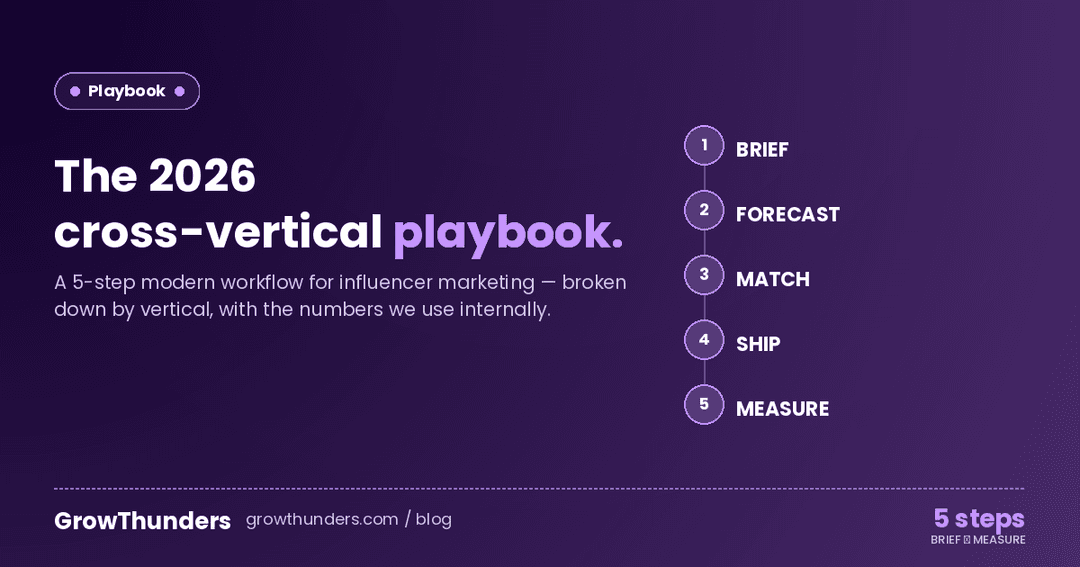
What to measure instead: a five-part framework
1. Incrementality testing (geo holdouts)
The gold standard. Run the campaign in 5–7 matched markets. Hold out 2–3 comparable markets. Measure the delta in total sales, branded search, app installs. If you can't run holdouts because your budget is too small per market, use time-based holdouts: pulse the campaign two weeks on, two weeks off, and measure baseline drift.
The math is not exotic. The discipline is. Most growth teams never schedule this because it feels like leaving money on the table during the holdout. It isn't. It's the price of knowing if anything is working.
2. Branded search lift
Pull your branded search query volume from Google Search Console and a tool like Glimpse or Semrush. Overlay your influencer posting calendar. The signal is almost always there and almost always ignored. A creator who drives a 22% week-over-week branded search bump is worth more than one who drove 400 click-throughs to a checkout that didn't convert.
3. Post-purchase surveys ("How did you hear about us?")
Low-fi. High signal. Add the question to your order confirmation flow. After 60 days you'll have a directional but real attribution model that captures the 60% of customers who'd never show up in your click data. Brands that do this consistently find creator-driven purchases are 2–4x what their last-click model claims.
4. Multi-touch attribution with creator-coded URLs and offer codes
Every creator gets a unique short URL and a unique discount code. Yes, codes get shared on Reddit. Account for it. The combination of UTM + code + time-window match against orders gets you a more honest claim than UTM alone. You're not aiming for perfection. You're aiming to stop being wrong in a known direction.
5. Media Mix Modeling (MMM), even cheap
You don't need a $400k Nielsen engagement. Open-source MMM (Robyn from Meta, LightweightMMM from Google) plus a competent analyst gets you 80% of the value in six weeks. Feed it your influencer spend by week, vertical, and market. The output will tell you the carryover effect — the part of creator value that shows up 3–8 weeks after the post drops, when last-click has long since closed the books.
The behavior change that's hardest
Stop reporting weekly influencer ROAS to your CMO.
Report it monthly, with a confidence interval. Pair it with branded search delta and post-purchase survey share. The first time you do this you will get pushback because the number "feels less concrete." Good. It is more concrete. It is less precise. Those are different things.
Precision without accuracy is how growth teams set fire to budgets while feeling rigorous.
What good looks like in 2026
A consumer brand we work with restructured measurement in Q3 2025. They went from:
- Before: weekly UTM-based ROAS, 1.4x average, cutting creators below 1.0x
- After: monthly composite score (UTM + code + branded search lift + post-purchase survey), 3.1x blended return
Nothing about the campaign mix changed for the first 90 days. Only the measurement changed. They stopped firing the creators who were doing the heavy lifting on the brand side. By month six, with the same budget, measured contribution to revenue grew 38% because they finally stopped cutting their best assets based on the wrong number.
The uncomfortable conclusion
If your attribution model can't see brand-building, it will systematically over-weight the bottom of funnel and under-weight everything that creates the bottom of funnel in the first place. Last-click is not neutral. It is an active bias.
The brands that win the next three years of creator marketing will not be the ones with the best creators. They will be the ones with the least dishonest measurement. Predictability comes from measuring the whole thing, not the lit part.