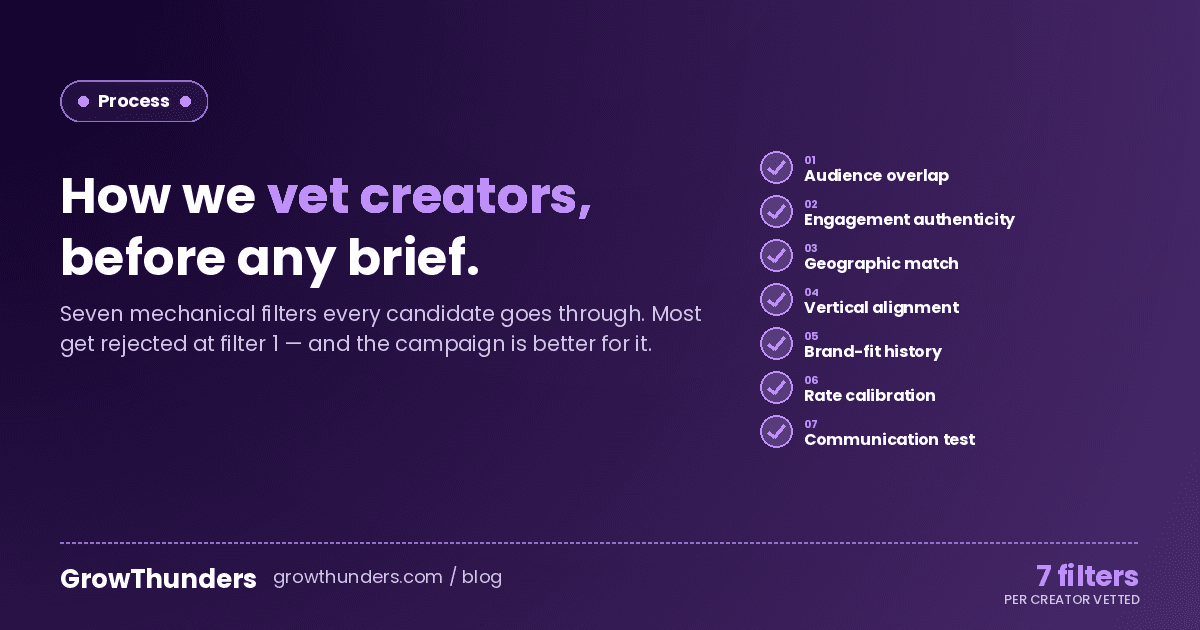
Across $8.2M of tracked creator spend on 1,400+ placements since 2023, the creators who passed all four stages of our vetting process hit CPA forecast within ±20% in 89% of placements. The creators we booked without completing all four stages — usually under client pressure to move fast — hit forecast in 41% of cases. The process catches what gut-feel misses.
Here is the full 4-stage framework, 28 checkpoints, and the kill criteria at each stage.
What is the GrowThunders 4-stage creator vetting process?
The four stages, in order:
- Audience verification (7 checkpoints) — is the audience real and relevant?
- Content audit (8 checkpoints) — does the creator make content that converts?
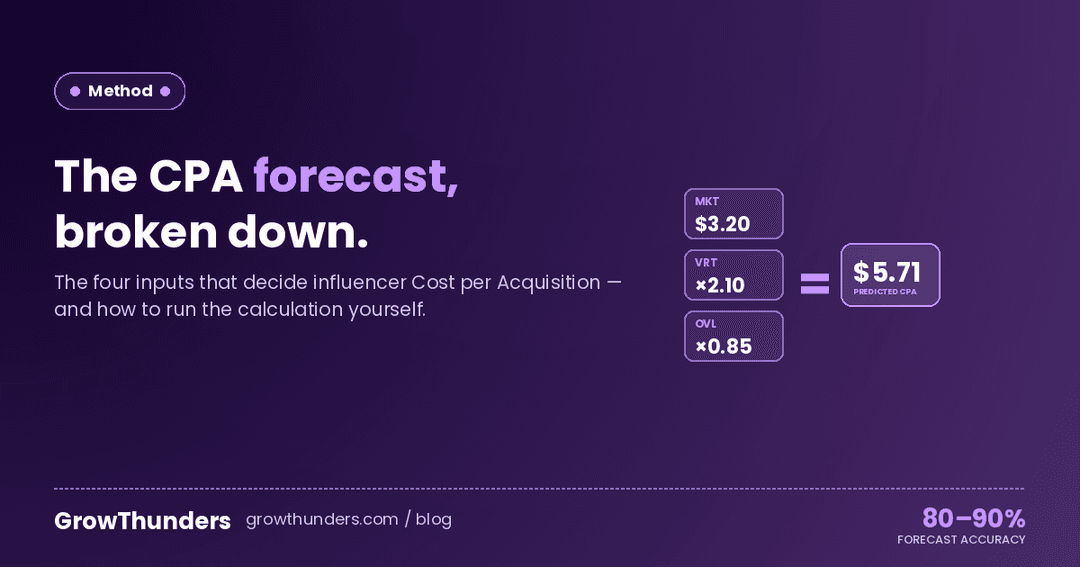
- Performance modeling (7 checkpoints) — what CPA does the data forecast?
- Commercial fit (6 checkpoints) — does the deal math work?
A creator must pass all 7 audience verification checkpoints before we even start stage 2. Most of our "no" decisions happen at stage 1.
Across 4,200 creators we have vetted since 2023, 31% are killed at stage 1, 24% at stage 2, 12% at stage 3, and 8% at stage 4. The remaining 25% become bookable inventory.
Stage 1: How do I verify a creator's audience is real?
Seven checkpoints, all must pass:
- Audience size vs engagement sanity check. Engagement rate over 12% on a 200K+ account is almost always bot-inflated. Kill if engagement rate is 3x the platform-tier median.
- Audience geography match. Pull HypeAuditor or Modash audience breakdown. If you are targeting Germany and 62% of the creator's audience is in India, kill.
- Audience age bracket match. Check against your buyer demo. 30%+ deviation = kill.
- Authenticity score above 75%. From HypeAuditor or Modash. Below 75% means significant bot or low-quality audience.
- Follower growth pattern. Pull the 12-month follower growth chart. Step-function jumps of 20%+ in a single week without a viral event = bought followers. Kill.
- Comment quality scan. Pull the last 5 posts and skim 100 comments. If over 25% are emoji-only, generic ("nice post"), or non-language matches, kill.
- Likes-to-views ratio on video. On TikTok and Reels, like-to-view ratio should be 4-12%. Below 3% suggests view inflation. Kill.
Stage 1 is the highest-volume filter. We kill 31% of pitched creators here in under 20 minutes of work.
Operator takeaway: the cheapest checkpoint is the one that takes 20 minutes and saves you a $15K placement that would have failed.
Stage 2: How do I audit a creator's content?
Eight checkpoints. We require 6 of 8 to pass:
- Native format match. Has the creator made content in the format you are buying (Reel, 60s video, dedicated YouTube, etc.) in the last 60 days? If no, downgrade by 30%.
- Sponsored content cadence. 15-35% of last 30 posts. Outside this range, flag.
- Sponsored content quality. Pull the last 3 sponsored posts. Watch them. Are they native or are they obviously read-from-a-script? Script-read content correlates with 40% lower CTR.
- Vertical relevance. Has the creator made organic (non-sponsored) content in your category in the last 90 days?
- Brand safety scan. No controversial content in last 12 months. Political, divisive, anti-competitive references = flag.
- Comment moderation. Does the creator respond to comments? An abandoned comment section is a dead audience.
- Cross-platform presence. Strong on one platform and dormant on others is fine. But total absence everywhere except one platform is a fragility flag.
- Recent post velocity. Post frequency consistent over the last 90 days. If they have posted twice in 60 days and now want to do your campaign, the algorithm has cooled on them.
Across 2,900 stage-1 survivors, 33% fail stage 2. Almost always on points 1, 3, or 5.
Stage 3: How do I model a creator's expected CPA?
Seven checkpoints, all feed into the forecast model:
- Pull historical CPM from creator's past brand deals in your vertical (via Modash or direct ask).
- Build a lookalike basket of 4-8 similar creators where you have run placements and apply their historical CPA range.
- Apply platform-tier-vertical baseline CPM from our benchmark dataset.
- Apply audience-product overlap score (1-10) as a multiplier on baseline CPM.
- Apply format-platform match score (1-10) as a multiplier.
- Apply seasonality factor for the planned posting window.
- Output: forecast CPA with confidence range (P25, median, P75).
If the forecast median CPA is over 1.5x the client's target CPA, kill. If it is 1.1x-1.5x, flag for renegotiation on creator fee. Below 1.1x, proceed to stage 4.
In our 2025 dataset, 17% of stage-2 survivors were killed at stage 3 because the math did not work at the asked fee. We came back to 6% of those with a renegotiated fee that did make the math work.
Operator takeaway: the forecast is the ceiling on what you should pay, not the floor on what the creator asks.
Stage 4: How do I confirm commercial fit?
Six checkpoints:
- Usage rights agreement. 365-day Spark Ads / Partnership Ads authorization in the deal memo. Kill if they refuse without a strong reason.
- Exclusivity in your category. Minimum 30 days post-campaign for similar competitive products. 90 days for direct competitors.
- Payment terms. Net 30 from invoice on organic, 50% upfront on usage rights. Anything more aggressive (50% upfront on everything) signals a creator who has been burned by other brands — investigate why.
- Cancellation and reschedule clause. 14 days notice with 50% kill fee is industry standard. Push back on anything tighter than 7 days at 80% fee.
- Approval workflow agreement. Single round of revision, 48-hour turnaround on draft approval. No "as many rounds as needed."
- Performance bonus or floor. Optional but powerful — a CPA-linked bonus on top of base fee aligns incentives. Floor not guaranteed but offered: "if we hit under $X CPA, you get a 15% bonus."
8% of stage-3 survivors fail stage 4, usually on points 1 or 2. Those failures are recoverable if the creator's team will renegotiate — about half do.
What does the 4-stage process catch that gut-feel misses?
The three failure modes we catch most often:
- Bot audiences with high engagement rates — the creator looks great on a pitch deck, the audience is fake
- Sponsored fatigue — the creator is over-saturated and their audience is tuning out brand content
- CPA fee mismatch — the creator's ask is 2-3x what the forecast supports
A senior buyer with 10 years of experience can spot 1 and 2 in 10-15 minutes. They cannot reliably spot 3 without a forecast model. The process exists to make the experience reproducible across a team and to put a number on the gut-feel.
Operator takeaway: if your vetting process does not output a forecast CPA with a confidence range, you are not vetting. You are auditioning.