Most influencer contracts get signed because someone on the marketing team felt good about a Loom walkthrough. Then the deal closes, the post goes live, and the post-mortem reveals that nobody asked the questions that would have caught the obvious problems.
Here are the 14 questions. They are not exhaustive. They are the minimum viable due diligence for any deal over $5,000. Use them. Save them. Hand them to your team.
On predicted outcomes
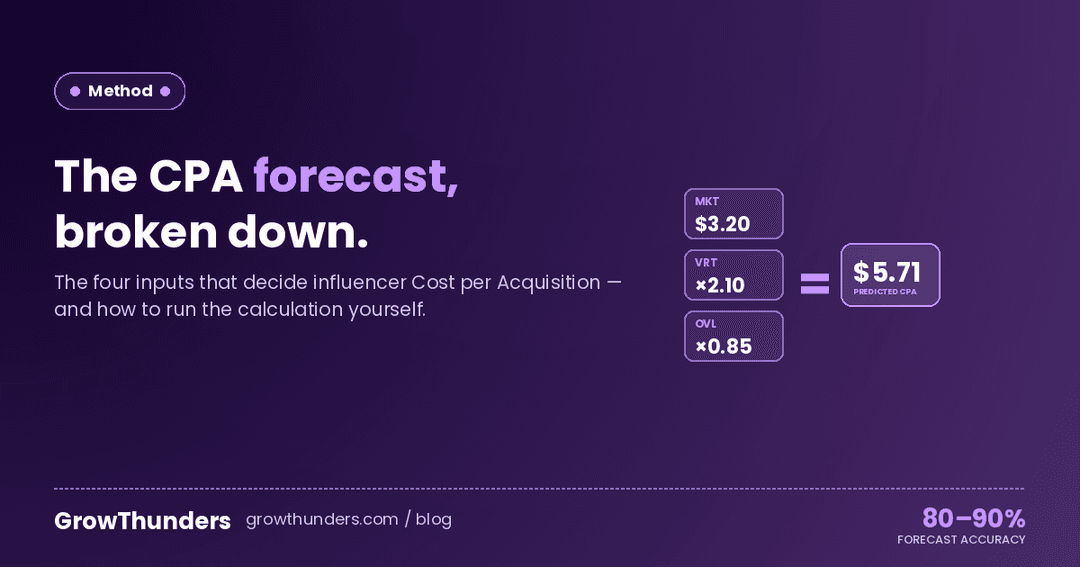
1. What's the predicted CPA on this creator, and what's the confidence interval?
If the agency or platform pitching you can't answer with a specific dollar number and a range, they're guessing. That doesn't mean don't proceed, but it means you should price the deal as an experiment, not as a commitment. "Predicted $18 CPA, 80% CI: $11–$28" is an answer. "Strong fit, we expect great performance" is a non-answer.
2. What's the predicted reach, and what's the historical accuracy of that prediction on your platform?
Reach predictions are easier than CPA predictions. There is no excuse for vagueness here. If they cite "expected 1.4M views," ask: what's your typical MAPE on view predictions? If they don't have a MAPE answer, they don't have a prediction. They have a hope.
On the creator's track record
3. Show me three campaigns this creator has run in my vertical in the last 12 months, with results.
Not "they're great for beauty brands generally." Show me the specific campaigns. Beauty CPA in skincare is not the same as beauty CPA in color cosmetics. Mobile games CPA in casual is not the same as mobile games CPA in midcore. Generic vertical fit is a red flag. Specific case studies are the floor.
4. What's the variance in this creator's performance across their last 10 campaigns?
A creator with average $14 CPA across 10 campaigns might have a range of $11–$17 (predictable) or $4–$80 (a coin flip). The variance matters more than the mean for budget planning. If they refuse to disclose, the variance is probably ugly.
On audience and overlap
5. What's the audience overlap with my existing paid social audiences?
If your Meta and TikTok paid campaigns already saturate the same audience this creator reaches, the incremental value drops sharply. You're paying creator rates to reach people you already paid Meta to reach. Modern platforms can estimate this. Ask.
6. What's the audience country split, in writing, from the creator's own analytics?
Not an estimate. Not a "we think." A screenshot from the creator's Instagram Insights or TikTok Analytics, dated within the last 30 days. If the agent refuses, walk away.
7. What's the age and gender split, and does it match my target ICP?
Same logic. Real data. Recent. In writing.
On the deal mechanics
8. Are payment terms tied to any performance outcome, or is it 100% flat fee?
In 2026 there is no excuse for 100% flat fees on deals above $10k. Even 20% of the fee tied to a basic outcome metric (view threshold, click threshold, engagement floor) aligns incentives and reduces your downside.
9. What are the usage rights, and what do they cost as a line item?
Whitelisting for paid amplification is often where the actual ROI lives. If usage rights are bundled and obscured, you can't make a clean buy decision. Demand them as a separate line item. Negotiate them separately.
10. What's the exclusivity window, and is it priced in or extra?
"90-day category exclusive" might mean nothing (creator wasn't going to take competitor deals anyway) or might be valuable (you're locking out a key competitor). Either way, know what you're paying for.
On compliance and safety
11. Has the creator received FTC/ASA/local-equivalent compliance training, and will the post clearly disclose?
This is not a polite suggestion. Non-disclosure is a regulatory risk to your brand, not just the creator. Confirm in writing the disclosure language they'll use.
12. What brand-safety screening has been done on this creator's last 12 months of content?
Old tweets, controversial statements, brand conflicts. If the answer is "we checked their grid," that's not screening. Ask for the actual screening output. The good agencies have a process. The lazy ones say "yeah it's fine."
On risk and downside protection
13. If the creator misses the deliverable deadline or the post underperforms by 50%+, what's the remedy?
Standard contract should include: makegood post obligation, percentage refund tied to view thresholds, or replacement creator at no additional cost. If the contract has no remedy clauses, you're absorbing all the downside. Push back.
14. Will you share post-campaign data back into my attribution stack within 14 days?
Including: full post analytics, audience breakdown, comment data, story view counts, swipe-up/link click data if applicable. If the agency or platform owns the data and won't share it, you are paying them to lock you in. Make data return a contractual requirement.
How to use this list
Three rules:
- Ask every question for every deal over $5k. Yes, every one. The discipline pays for itself within three deals.
- Score the answers. Track how vendors respond over time. The good ones improve their answers. The bad ones get worse.
- Walk away from deals that fail more than 4 of these. It is almost always a worse deal than it looks, and saying no is the cheapest growth lever you have.
The meta-question
Behind all 14 is one underlying question: does the seller of this creator deal have skin in the game on the outcome, or are they paid the same whether it works or not?
If the answer is the second, you are the only person at the table whose money is on the line. Act accordingly.
Print this list. Use this list. Your CFO will thank you in Q4.