
Across 280+ mobile game placements we ran for 23 publishers between January 2024 and December 2025, YouTube delivered a lower blended CPI than TikTok in 4 of 9 genres — and a higher D7 retention rate in 7 of 9. The lazy answer "TikTok for hyper-casual, YouTube for mid-core" is right in direction and wrong in magnitude. Here is the actual data.
What is the average CPI for influencer marketing on mobile games in 2026?
Median CPI from our 2025 placements:
- Hyper-casual: TikTok $1.80, YouTube Shorts $2.40, Instagram Reels $3.10
- Hybrid-casual: TikTok $3.20, YouTube Shorts $3.80, YouTube long-form $4.20
- Puzzle (Match-3, etc.): TikTok $4.40, YouTube $4.10, Instagram $5.80
- Idle / Merge: TikTok $3.90, YouTube $3.60
- 4X / Strategy: TikTok $14.80, YouTube $9.20, Twitch $11.40
- RPG / Gacha: TikTok $18.40, YouTube $11.60, Twitch $13.20
- Sports / Racing: TikTok $8.10, YouTube $6.40
- Simulation: TikTok $5.60, YouTube $4.80
- Casino / Social Casino: TikTok $22.10 (restricted), YouTube $14.30, Twitch $9.80
In 5 of 9 genres, YouTube is cheaper on CPI alone. That contradicts the consensus you will hear at MAU and Pocket Gamer Connects.
Operator takeaway: if your UA lead says "TikTok is always cheaper for games," ask them which genres they tested in the last 90 days.
When does YouTube beat TikTok for mobile gaming UA?
YouTube wins on three vectors in mid-core and hardcore genres:
- Lower CPI for 4X, RPG, sports and simulation in 2024-2025 data
- Higher D7 retention — across all 280 placements, YouTube-acquired users had 31% higher D7 retention than TikTok-acquired users
- 2.4x higher D30 ARPDAU in our 4X dataset
Why: YouTube viewers self-select for 8-15 minute content. They watch a gameplay video, they understand the mechanics, they install with intent. TikTok viewers see 15-second clips and install on dopamine — the conversion is cheaper but the user is fundamentally less invested.
For a 4X client in Q3 2025, a YouTube integration with a 4M-sub strategy creator delivered $9.40 CPI, 42% D7 retention and $14.20 D30 ARPDAU. A parallel TikTok campaign delivered $11.80 CPI, 18% D7 retention and $4.10 D30 ARPDAU. The TikTok CPI looked competitive. The LTV was a third of YouTube's.
When does TikTok beat YouTube?
Hyper-casual and hybrid-casual, full stop:
- TikTok CPIs in hyper-casual were 25% lower than YouTube Shorts in 2025
- Volume ceiling on TikTok is 3-5x higher per dollar
- Creative iteration speed favors TikTok — you can refresh 8-12 hooks in a week
Hyper-casual economics need cheap installs at massive volume. The user is not going to retain past D14 anyway. TikTok wins.
For a hyper-casual client in Q4 2025, we ran 47 TikTok creators across 14 days. Result: $1.60 CPI on 312,000 installs, $0.21 D1 ARPDAU. Same client ran YouTube Shorts in parallel at $2.30 CPI on 38,000 installs. TikTok was the obvious play.
Operator takeaway: if your D7 retention target is under 10%, TikTok. If it is over 20%, lean YouTube.
What creator tier should I use for mobile gaming?
Our 2025 dataset, by genre:
- Hyper-casual: micros (10K-100K) at $400-$1,200 per post. Volume is everything. We run 30-60 creators per campaign.
- Hybrid-casual: micros and mid (100K-500K). We use mid creators for hero content and micros for amplification.
- Mid-core (puzzle, idle, sim): mid creators are the sweet spot. Macros do not move the needle proportionally.
- Hardcore (4X, RPG, gacha): macros and mega gaming creators. Trust signal matters because the install is a 6-month commitment for the player.
The mistake: using mega creators for hyper-casual. We see this constantly. A $40K mega-creator placement for a hyper-casual game delivers a $4.80 CPI on 8,300 installs. The same $40K across 50 micros delivers $1.80 CPI on 22,000 installs. The mega creator is 2.6x more expensive per install and produces a worse-converting audience.
How do I forecast mobile gaming influencer CPI?
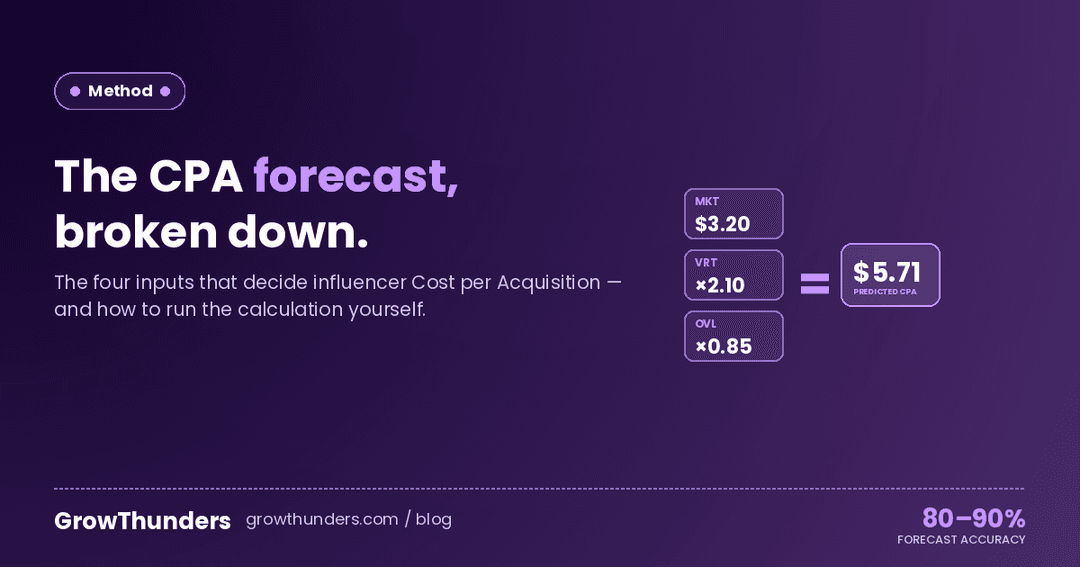
The four inputs we use in our forecast engine:
- Genre-platform baseline CPM (e.g., TikTok 4X = $14.80 CPM in our 2025 dataset)
- Creator historical install rate for the same or adjacent genre — from past placements or scraped public data
- Audience-game fit score (1-10) based on creator audience demographics vs game target
- Creative format match — if the creator does not natively do gameplay content, downgrade by 30%
Across 280 placements, this four-factor forecast landed within ±25% of actual CPI in 81% of cases. The misses were almost always creative-format misalignment we should have caught (a lifestyle creator forced into a gameplay format).
Operator takeaway: never book a creator for a game without verifying they have shipped at least 3 native gameplay videos in the last 90 days.
What is the optimal campaign structure for a mobile game launch?
Our 4-phase launch playbook, used across 14 of 23 publishers in 2025:
- Soft-launch validation (weeks 1-2): 6-10 micro creators in Poland, Brazil and Spain. Goal: confirm CPI floor and D7 retention before global scale.
- Hero content (weeks 3-4): 1-3 macro or mega creators in Tier 1 markets. Goal: brand search lift and trust signal.
- Volume push (weeks 5-8): 30-60 micro creators globally, Spark Ads amplification on top performers.
- Always-on creator squad (week 9+): 8-15 returning creators on monthly contracts for retention storylines and event launches.
The publishers who skipped phase 1 (soft-launch validation) overspent on phase 3 by an average of $180K because they scaled before knowing the CPI was viable. That is the entire reason we built the forecast engine.