

A consumer lending app — licensed in five EU jurisdictions, regulated as a credit institution in two of them, profitable on direct response in Poland, planning rollout into ES and DE. The growth team had a working playbook on Google and a half-working playbook on Meta (compliance flags slowed creative iteration to a 2-week cycle). They had never run influencer at scale because the previous head of marketing flatly refused to put a regulated financial product in the hands of creators.
The new VP Growth came from gaming UA. She wanted to test creator as a channel because the unit economics math was compelling: if creator-sourced borrowers converted at even half the rate of Google-sourced borrowers, the LTV-to-CAC ratio would still beat their current blended.
Their borrower LTV (12-month, net of defaults): €380-€440 depending on market. Their Google CAC: €32 at the install layer, €110 at the approved-loan layer (only ~29% of installs complete KYC and get approved). Their constraint: anything they ran had to clear (a) financial promotions regulation in each target market, (b) their internal compliance team's 7-point screening checklist, and (c) explicit no-cold-DM / no-affiliate-spam clauses in creator contracts.
The brief to us was narrow: can you run 5-10 creators in PL/ES/DE without giving the compliance team a heart attack, and can the unit economics hold?
What we forecast
Forecast engine pulled from 14 prior fintech/financial-services placements across EU (2023-2025), filtered for regulated consumer credit or comparable categories (BNPL, neobank lending products). Smaller comp set than our gaming or beauty work — fintech is the vertical where we have the thinnest reference data, and we said so upfront.
Predicted CPA range: $5.10 – $6.20 at 75% confidence (note: lower confidence band than gaming/beauty forecasts because of the smaller comp set). Central estimate: $5.50. We modeled CPA at the install layer; the more important number for the client was approved-loan CAC, which we forecast at €105-€135 based on a modeled 30-35% install-to-approval rate.
Predicted view volume: 1.1M – 1.5M, lower than other verticals because we deliberately weighted toward smaller, higher-trust creators.
Why YT + IG, no TikTok: TikTok's content moderation around financial products in EU is inconsistent across markets, and we'd had two prior client campaigns where TikTok pulled creator content mid-flight for "misleading financial claims" even after pre-clearance. We weren't going to relitigate that fight on a regulated lending product. YT's policy is clearer, IG's enforcement is more predictable, and both are where the target borrower demo (28-45, not students, not retirees) actually spends time.
What we did
7 creators across PL/ES/DE — deliberately small roster. Every creator went through three layers of screening:
- Our pre-screen: no prior placements for unregulated crypto, no gambling promotions in the last 24 months, no content that promotes debt-fueled lifestyle spending, no audience skew below 25.
- Client compliance review: 7-point checklist on the creator's last 50 posts.
- Legal review of the contract addendum specific to each market's financial promotions rules.
Roster:
- PL: 3 creators (1 YT 280K — personal finance vertical, 1 IG 140K — small business/freelancer audience, 1 YT 95K — younger millennial finance)
- ES: 2 creators (1 YT 220K — finance/economy explainer, 1 IG 180K — entrepreneurship)
- DE: 2 creators (1 YT 310K — Finanztip-adjacent personal finance, 1 IG 110K — Selbstständige/freelancer audience)
Formats: long-form YT (10-22 minutes) where the lending product was one option discussed among several (we explicitly briefed creators to discuss alternatives, including not borrowing — this was a compliance requirement and turned out to be a performance feature). IG was carousel + Stories, with mandatory APR disclosure and representative example formatting.
Timeline was slow on purpose: 4 weeks of creator screening and contracting, 6 weeks of staggered publishing with a 5-day minimum gap between posts in the same market (so compliance could review each one's performance and audience response before the next went live), and 4 weeks of tail tracking through to approved-loan attribution.
No cold DMs. No affiliate codes that resembled spammy promo offers. Disclosure language was pre-approved per market and creators couldn't deviate.
What happened
D90 final numbers:
- Spend: $42,000
- Attributed installs: 8,235
- Blended install-CPA: $5.10 (forecast central: $5.50 — beat by 7.3%)
- Install-to-approved-loan rate: 14.0%
- Approved-loan CAC: €36.40 per approved borrower
- vs Google approved-loan CAC of €110: a 67% lower CAC at the layer that actually matters for unit economics
By market:
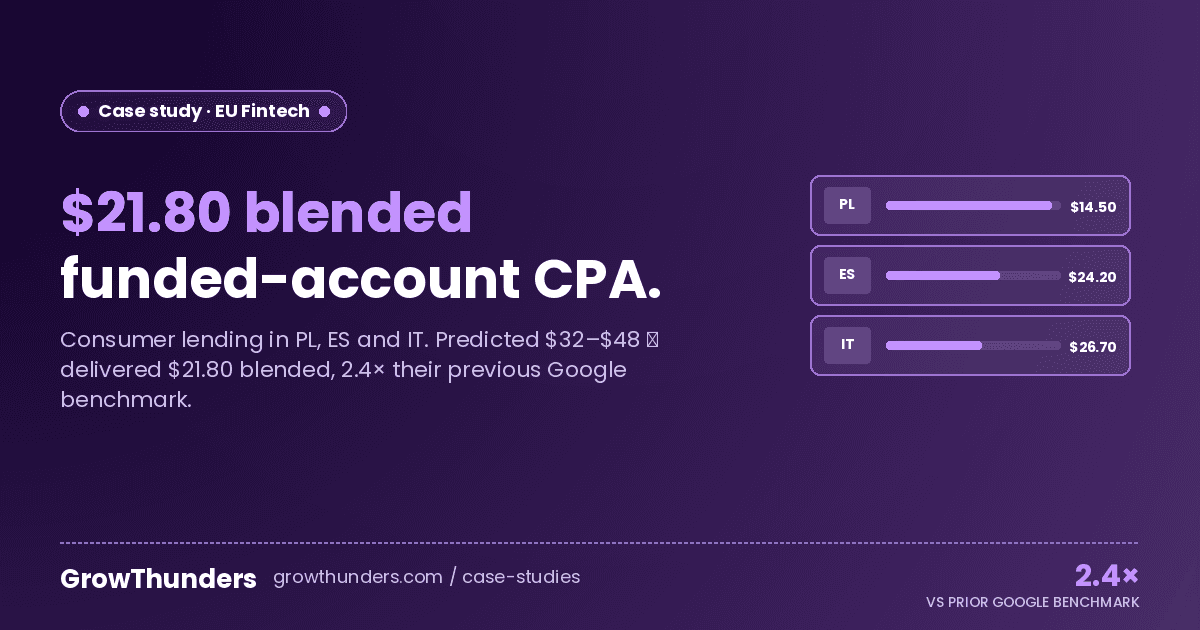
- PL: $4.40 install-CPA. Best performer. The 280K YT personal-finance creator delivered $3.20 CPA and a 17.8% install-to-approval rate — highest in the campaign. Polish audience trusts personal-finance YT in a way other markets don't quite match.
- ES: $5.60 install-CPA, 12.1% approval rate. The 220K YT creator drove most of the volume; the IG entrepreneur creator drove lower install volume but a 19% approval rate (smaller, higher-intent audience).
- DE: $5.80 install-CPA, 13.2% approval rate. Slowest to ramp — German audiences sit on a financial decision for 8-14 days before acting. We saw the conversion tail extend well into weeks 11-13 in DE specifically.
Default rate at D90 on creator-sourced loans: tracking within 0.4 percentage points of the Google-sourced cohort. Too early to call definitively, but the early signal is that creator-sourced borrowers are not adversely selected.
The lesson
Fintech does not behave like mobile gaming or beauty. The campaign cycle is roughly 2-3x slower (14 weeks vs 6-10), the creator roster is smaller and more expensive per head, and the compliance overhead is real — not a line item to be optimized away. Anyone who tells you they can run a regulated financial product through the same playbook as a mobile game is either lying or about to get a regulator letter.
But the unit economics close the gap. With approved-borrower LTV at €380-€440 and a CAC of €36 at the approved layer, the LTV-to-CAC ratio is roughly 10-12x at the cohort level — three to four times what we see on most mobile gaming campaigns even after their lower CAC. The slower cycle and the compliance work aren't tax; they're the qualification process that produces a much higher-quality user at the end of the funnel.
The operator move: don't budget fintech campaigns on a CPA-only basis. Budget on cost-per-qualified-conversion at the layer that actually drives LTV, and price the compliance work into the campaign timeline upfront rather than treating it as a surprise.
What it means for your campaign
If you're running a regulated product — lending, insurance, neobank, BNPL, even regulated supplements or health — and you've avoided creators because the compliance lift looked prohibitive, the math is probably worth re-running. The CAC-at-conversion-layer is where this channel wins, not the CPI/install layer where most agencies report results.
When we forecast for a fintech client, we forecast at the conversion layer that matters to your P&L, not the vanity install layer. That changes which creators we recommend, which formats we propose, and which markets we suggest you start in. If your previous creator pitch came with a CPA number and no LTV-adjusted CAC, you weren't shown the number that decides whether the campaign was actually worth running.